
 Posts
Posts


Showing posts with label hidden object game. Show all posts
Showing posts with label hidden object game. Show all posts
Thursday, February 12, 2009
Shop-n-Spree
Shop-n-$pree is a hidden object game. While the company bills it as a time management game, the time management is similar to most hidden object games, where one must find all the objects within a certain amount of time.The backstory: Your long-time family department store has seen better days. A shopping super-center comes into town and tries to buy up your lot for additional parking, you enter with your buisness degree to the ailing family business.
Game play: You find the objects that the customers order. You will have a maximum of 3 customers at a time. Some of them will have text (red pillow, blue slippers), some will show you a picture of what they want, some will have a a request and timer (i.e. Give me all the globes you have, and the timer starts running - you have until the timer runs out before the customer gets angry and leaves); some have a "riddle" (My nephew wants 3 green stuffed animals).
What they did well: As the different levels load (bathroom, sporting goods, boy toys, etc), there is a box that lists a bunch of items with their prices and pictures. The items don't vary from this list, so if you don't know what something is (for example, you've never done rock climbing and don't know what a carabiner looks like), this could help out.
What could have been better: Sometimes the photographer customers had a picture of what they wanted that was not the same as the actual item! There was no reward for finishing a level early. Upgrades are not choices, but given after a certain number of levels. The upgrades don't affect gameplay. It gets tiresome to listen to the customers says "Okay" and "Thanks" over and over.
Overall: This was not a game that I found very compelling, but think it's best targeted to younger players.


Tuesday, October 14, 2008
Cassandra's Journey: The Legacy of Nostradamus
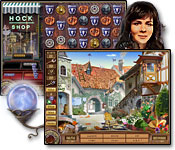
Cassandra's Journey: The Legacy of Nostradamus brought to you via JoyBits, is a mostly hidden-object game.In addition to the levels, there are 3 "divination" games that are unlocked via progressing through the story. They are unlocked at levels 4, 13, and 20.
The story is that a woman comes to you, Cassandra, who has recently started her divination business. She wants to find her brother. You have inherited your grandmother Serena's sense of fortune-telling, but need additional help from Nostradamus' ring. You start to have a vision of him, which oddly starts out with him IMing you.
There are two gameplay options: timed or relaxed. Like most hidden object games, there are penalties for random clicking (30 seconds), and hints that can be collected throughout the levels. There are blue, red, and green gems, which are banked as points. You spend the points on one of 3 items to help locate: a wand that glows brightly when lit (2 points), a general area highlight (1 point), or an object locator (3 points). The points add up quickly so if you want to be a lazy player and not look hard, there are lots of opportunities to acquire and use the hints. However, you get a time bonus and bonus points for not using jewels and/or hints, so to maximize your score, you want to use as few as possible.
There are other puzzle types: click to place the tile; "fix" something in the hidden object screen (reassemble a pizza; a building roof), match 3 to get a key and jewels, a semi-crossword, etc.
What they did well: The intro music was nice. It does have multiple types of puzzles to solve. They use the gamut of hidden object lists: riddles, puzzle pieces, lists, outlines. For their find-a-difference puzzles, there were 3 pictures instead of two, which made it slightly more challenging. They also used crosswords and match-3.
What they could've done better: First, proof-read. The text has quite a few glaring spelling errors. Plus, the conversations made little sense and the characters were less than believable. I'd prefer you not give me characters and text to read unless it really means something. Level 11 was very annoying to me, because you really don't do anything. The circles around the find the difference scenes made it difficult to detect the last few differences because the circles were so large. The book to start each level has even and odd pages. The odd pages automatically updated the picture to the left, which you could click on to start. In order to access the even pages, you had to physically click on the page on the book, then the picture. I encountered a bug that made a ticking sound loop over and over. Closing and restarting the game fixed the problem, but it happened more than once. Each divination can only be accessed once a day. There were a few random, odd voice-overs. I was very disappointed in the "magic tricks" which were glorified logic puzzles, optical illusions, and puzzles that have been passed around in e-mails for a long time.
Overall, it was not a very solid game, but kids and fans of hidden object games who want to play all varieties might enjoy it.
Hints (spoilers):
On the first find a difference:
Crow, bunny, pizza, scarf, sandwich on table, chair placement, sunglasses on head, picture (red shirt), photographer's bag
Words in crossword:
page2: forune, that, grandmother, magic, guess
page 3: Ring, help, have, mission(6)
page 4: greatest, talisman, with, thing
Chapter 13 find-a-difference:
chair, chick, banana, gramophone, postman, leaf, basketball, cactus, crow tag, small picture on board
Wednesday, September 17, 2008
mystery chronicles: murder among friends
Mystery Chronicles: Murder Among Friends is a hidden object game from Lazy Turtle Games.The setting is France, around the turn of the 20th century. Your cousin and wife were killed, and their butler and children are missing. It's your job to solve the crime. You have the option of playing in either the relaxed or the timed mode. Each chapter starts with 45 minutes on the clock. As with all hidden object games, there is a list of items to locate, and a hint to help. In this case, it's a magnifying glass. Clicking on it highlights one object still unfound on the screen. It takes 2 full minutes to recharge. There are multiple scenes in most chapters, and clicking on the footprints in the lower right hand box opened up the additional scenes, in case you get stuck and want to move on to finding something else.
I found I had to click seven times in quick succession before I encountered a time penalty (30 seconds). However, slow random clicks did not seem to have any effect. There are no bonuses for locating multiple objects in quick fashion.
What was done well: mini-games intersperse the hidden object scenes. You may have to play a game similar to minesweeper or piece together paper fragments, as examples. The story was intriguing. Items frequently looked the same from scene to scene (i.e. the brown briefcase you collect from the first location of the Mansion will be the same brown briefcase in other scenes as well).
What could have been better: I found the objects frequently blended in with the background. For example, in the first location, the mansion, the bullet hole in the window was difficult to locate. In the garden, the coffee grinder in the weeds was impossible for me to discern. There was no way to magnify an area, which contributed to my frustration in locating blended objects. Occasionally, there were items that I had not heard of (i.e. Hanoi tower - the ring tower). Many of the items to find had nothing to do with solving the mystery. In one scene, there is clearly a dead body. Clicking on it prompted no action. It wasn't until the end of the scene that you "discover" the body in text. That was too contrived for my tastes.
Recommended for: hidden object mystery fans

Monday, August 25, 2008
Go-Go Gourmet, Chef of the Year
Go-Go Gourmet: Chef of the Year is the second in the Go-Go Gourmet titles. In this one, Ginger is competing for Chef of the Year against 7 of the world's best chefs.The play style is exactly the same as for Go-Go Gourmet - a mixture of hidden object and time management styles. The added twist is a like reality cooking show, where judges score the recipes (based on speed). Final point totals given each chef a placement. Chefs can even be eliminated! Go-Go Gourmet, Chef of the Year differs from the first one in that items no longer move around the kitchen like they did in Go-Go Gourmet. Each country's kitchen has a different layout, but the items are fixed.
Collectibles are plentiful. Every time the player places first, there is a bonus. Either an upgraded item (fry pan, chopper, etc), a collectible (vases, teddy bears, etc), or a bonus chef's outfit are added. The bonus outfits give different boosts - one makes Ginger faster, one adds bonus points to each delivered dish, and and one makes the judges more patient. There are even printable recipes that can be unlocked.
At each stage in the game, Ginger starts off with the basic kitchen, and must place first to get the bonuses for each country. In between the addictive, fast-paced finding and cooking, there are cute cut scenes where Ginger interacts with the other Chefs. There are also bonus rounds, which might involve placing items in their correct locations, collecting all of the items on a list, or picking up all of a specific type of item.
Go-Go Gourmet, Chef of the Year is similar to the original game (even the music is the same), but it is enlivened by the judging aspect. Its fast-paced levels are very addicting.

Sunday, August 10, 2008
Forgotten Riddles - Moonlight Sonata
Forgotten Riddles: The Moonlight Sonatas is a hidden object game, but is a bit genre-bending, similar to Mystery Case Files: Madame Fate™. Currently, Forgotten Riddles: The Moonlight Sonatas is exclusively offered from BigFishGames, and is a top download.In Forgotten Riddles: The Moonlight Sonatas, you are an investigator assigned to solve the mystery of the Opera House, which used to be the home of famous composer and child prodigy Francis von Amadeus. People have reported seeing a ghostly, gaunt figure and to hear music playing at odd times.
Fans of hidden object games will feel right at home. Instead of giving a list of objects to find, there are musical symbols at the bottom of the screen. Players select them to get a clue. From that clue, they locate the object. For example, one of the clues reads "On a pedestal golden I'm Earth recreated; I display every country whenever I'm rotated." The player finds a globe and clicks on it.
When starting the game, players can choose two levels of difficulty: archaeologist (harder) and apprentice (easier). Interestingly, players can not read through all the clues, then click on the items in succession. The correct object is the only one that pertains to the current riddle. There are no points given or special rewards for fast selection. Players advance from one chapter to the next by solving the correct number of riddles(finding items).
The chapters have sufficient amounts of time, even in the archeologist category. Time wise, they provided 45 minutes to solve 40 riddles. There is a hint compass that starts with 5 hints. Random clicking results in a 40 second penalty.
One of the ways Forgotten Riddles: The Moonlight Sonatas is different from most other hidden object games are the puzzles that must be solved to unlock rooms. For example, on the first chapter, there is a stage scene, with items underneath the scene. The player must place the items in the correct places for the scene to change. Not all of the objects can be placed immediately, as the scene will dynamically update. Once the puzzle has been solved, the objects to be found will be located in the unlocked room or on the previous scene. There is a button at the right hand screen corner to switch back-and-forth. Another difference is that the hidden object, once found, does not become removed from the picture.
I found Forgotten Riddles: The Moonlight Sonatas to suffer from some repetition, primarily because of the setting. Using only one location (the opera house) was a bit limiting. Also, the story felt almost like an afterthought, as it wasn't well integrated into the game itself.
Overall, Forgotten Riddles: The Moonlight Sonatas is a good game and should please fans of hidden object games.

Tuesday, August 5, 2008
"The Race"
The Race, a hidden object game, is available from the BigFishGames website today. The Race is developed by Gogii games.As the game starts, you choose from one of 6 teams. The appearance of the 6 teams are: muscles, hicks , "euro" couple, mom/daughter, grandparents, or Ken and Barbie. I wondered if the team choice influenced any of the play, but it does not appear to.
There are 3 venues: Country, Continental, and World championships. Starting out with Country, you begin in Canada. There are 3 sites where you locate 10 hidden objects, and "race" against the other teams to see which team can find the objects fastest. For each site, you get a magnifying glass that allows you to zoom in on the objects. There are 3 tools that help you to locate objects: a hot/cold cursor, a compass, and a time bomb that will send the team closest in time back.
The teams that finish first through third receive points. The points are talleyed for each country, and an overall winner is declared.
Like most hidden object games, there is a penalty (5 second) for random clicking. There are no bonuses for finding items in quick succession.
The music at the intro screen heightens excitement, but the music during the play is mediocre. Overall, this is not the most challenging or pretty hidden object game I've played, but it wasn't terrible. I found that the resolution of the magnifying glass was very grainy and unlikely to help me locate small or shadow objects. I was disappointed that a choice of teams had no effect on the outcome. Also, one of the things that keeps me replaying a casual game is having "achievements" I can unlock (such as getting 100% accuracy at 10 locations, or placing 1st 10 times.) This game did not have achievements.
I think this game would be great for kids, or people new to hidden object games, as it wasn't that challenging. It seemed to me that if I took a long time to find my first object, the other teams also got off to slower starts.
Happy hunting!
Subscribe to:
Posts (Atom)
